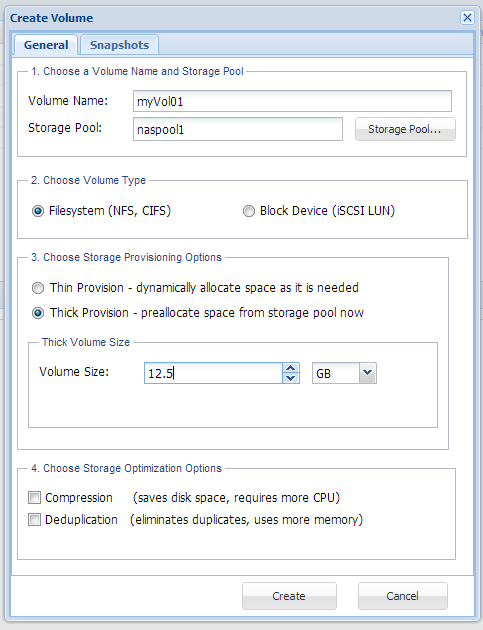
Volume Name
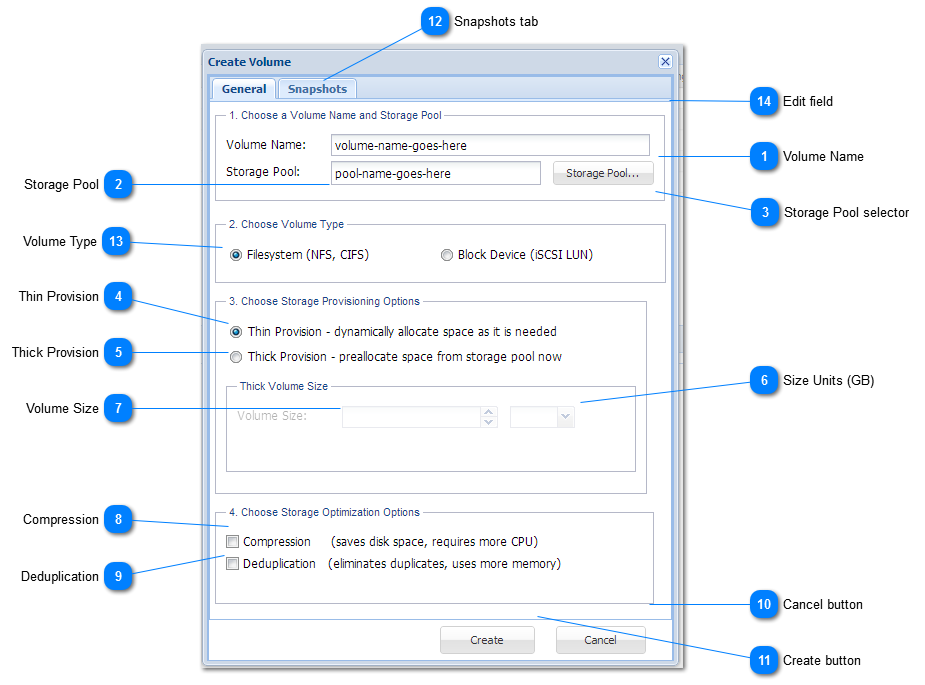
Enter the name of the new volume. Volume names start with alphabetic characters, followed by any combination of alphanumeric, underscore, dash and period (however, volume names may not begin with the reserved names "c0" to "c9").
The volume name will be appended to the pool to create a unique filesystem path; e.g., volume named "myVol" in storage pool "naspool" will appear as "/naspool/myVol" in the Linux filesystem (and for sharing purposes).
|
 Storage Pool
Enter the name of an existing Storage Pool (or choose the Storage Pool... button to select a pool from a list).
Storage Pool names start with alphabetic characters, followed by any combination of alphanumeric, underscore, dash and period (however, names may not begin with the reserved names "c0" to "c9").
|
 Storage Pool selector
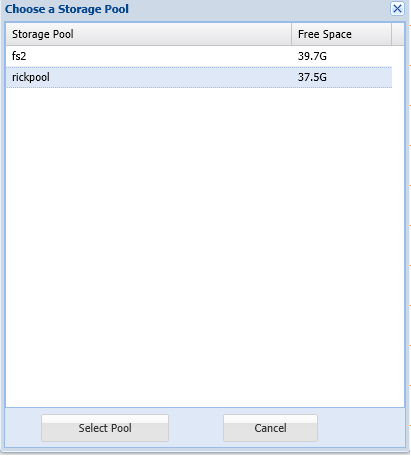
Press the Storage Pool selector button to choose a storage pool from a list. After pressing the Storage Pool selector button, the following list will appear.
Choose a Storage Pool by: a) double-clicking on the row with name of the desired pool, or b) select the desired pool with a mouse left mouse click, followed by pressing the Select Pool button.
|
 Thin Provision
 Thin Provision
By default, volumes are thin-provisioned. Thin-provisioning allows a volume to acquire storage from its Storage Pool on an as-needed basis, as new data is written to the volume. Thin-provisioning enables many volumes to share a storage pool without an upper limit being placed on the volume itself (the only upper limit to the volume's size is available space in the pool).
|
 Thick Provision
 Thick Provision
Select the Thick Provision button to pre-allocate and reserve a specific amount of space for the volume. Thick-provisioned volumes reduce the amount of space available in the Storage Pool by reserving this space for use by a specific volume. When a thick-provisioned volume reaches its maximum volume size, no more data can be written and a volume full error will be returned for writes to a full volume.
Thick-provisioned volumes can be re-sized at any time to add space (or return space to the storage by by reducing the volume size).
When Thick Provision is chosen, the Thick Volume Size must be specified.
|
 Size Units (GB)
The Size Units selector is used to choose the units for the Volume Size (default: GB or Gigabytes). The following values may be selected by clicking on the combo box control and choosing an item:
MB - Megabytes
GB - Gigabytes (default)
TB - Terabytes
|
 Volume Size
When Think Provision is selected the Volume Size specifies how much space is to be pre-allocated to the volume. Space is determined by entering a Volume Size amount as a floating point value, along with choosing the Size Units. Once a Storage Pool has been selected for a thick-provisioned volume, the amount of available space to allocate is displayed below the Volume Size field, as shown in the example below.
The Volume Size value can be any valid numeric value; e.g., 10, 12.5, 100.0, 1.25
|
 Compression
Select the Compression checkbox option to compress all data stored on the volume. Compression saves disk space, at the expense of additional CPU overheads for each read and write request (to decode and encode the data). Depending on how compressible the data is, it is common to see data compression rates up to 50% or more.
Note: If you compress a significant amount of data, be sure to observe the amount of actual CPU consumed during a typical day, and if necessary, add more CPU capacity to the SoftNAS VM as required to ensure compression is fast and efficient. If data is not highly-compressible, then disabling compression provides a better performance tradeoff.
|
 Deduplication
Select Deduplication to eliminate duplicate disk blocks from being written to disk. For certain types of data (e.g., Windows virtual machine images, which are highly-redundant in virtual desktop applications), deduplication can save up to 80% on storage requirements by eliminating duplicate data. Each time a duplicate data block is to be written, a pointer to the existing duplicate block is created instead, along with increasing the duplicate block reference count. To make these operations as fast as possible, a table of deduplicated blocks is maintained. A hash table of deduplicated blocks is kept in memory to make lookups very fast. When a duplicate block is read, it is usually in cache memory and is simply returned with no disk I/O required.
It is recommended to avoid using deduplication unless the data is highly-duplicative, because of the memory impact of deduplication. It is estimated that for every terabyte of deduplicated data managed, one gigabyte of memory is required for the deduplication lookup tables. These tables compete with cache memory, which can reduce the overall performance of SoftNAS. For more details on best practices for use of deduplication, please refer to System Requirements. |
 Cancel button
Cancel this dialog without creating a volume.
|
 Create button
Press the Create button to proceed with volume creation. If the volume is successfully created, a few moments after the Create button is pressed, the new volume will appear in the volumes list.
|
 Snapshots tab
Click on the Snapshots tab to view and configure how snapshots are handled for the volume.
|
 Volume Type
Choose the type of volume to create:
- Filesystem - volume containing filesystems, shared using NFS or CIFS
- Block Device - volume containing "raw device" blocks, shared using iSCSI
Note that when you choose a Block Device, the storage provisioning is automatically set to "Thick Provision", and a fixed amount of storage must be allocated. This is because block devices accessed via iSCSI require a reliable set of blocks for reliable operation, so thin-provisioning of block devices is not allowed to prevent accidental iSCSI failures due to a storage pool running out of space.
|
|